Blood motif
Stephen King Three Classic Novels Box Set: Carrie, 'Salem's Lot, the ShiningBlood is a central organizing motif in Carrie White: it marks puberty and birth, is made into evidence of sin by Margaret White, and becomes the material of public humiliation and revenge. Its meanings accumulate rather than settle. What begins as a bodily change Carrie cannot understand is interpreted by others as contamination, then recast as a religious curse, and finally repeated as a deliberate spectacle at the Spring Ball. The novel’s movement from a few drops on a school shower-room floor to bloodshed in the White home and destruction across Chamberlain makes private shame inseparable from collective violence.
The Body Made Public
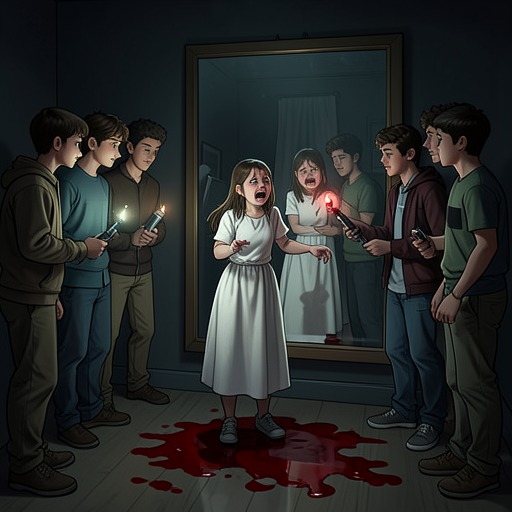
Carrie’s first menstruation gives the motif its defining social force. She leaves the shower and only then do the girls see blood running down her leg. Standing in the forming circle, wet and bewildered, she is already accustomed to being the joke; Sue Snell responds with disgust and tells her to clean herself up. The blood is a physical fact, but the girls turn it into a public spectacle, surrounding Carrie with mockery rather than helping her understand what is happening. Their behavior makes an ordinary bodily transition feel like exposure and danger.
The assault becomes still more degrading when sanitary napkins are thrown at her and the girls urge her to stop the bleeding. In later discussion of the incident, Henry Grayle identifies the cruelty plainly: Carrie believed she was bleeding to death, while the girls subjected her to physical and verbal abuse. The school’s response imposes one week of detention on the girls, with Rita Desjardin taking charge of the punishment in the gym and promising to run them ragged. That sanction acknowledges misconduct, but it cannot undo the meaning the scene has fixed for Carrie: blood has become the sign by which her body is singled out and her isolation enforced.
This first exposure also coincides with the emergence of Carrie’s Telekinesis. A later account in The Shadow Exploded argues that the ability may surface in moments of extreme personal stress and that the absence of recorded childhood incidents does not prove it was absent. Blood and power therefore enter the story together, not as a simple supernatural cause-and-effect but as two forms of a change Carrie cannot safely disclose or control. The body that others shame is also the source of a hidden capacity that will later answer their violence.
Margaret White’s Theology of Blood
Margaret White gives blood a religious explanation that intensifies rather than relieves Carrie’s fear. In her account of Adam and Eve, intercourse and childbirth are curses visited on women; blood belongs to a history of sin, punishment, and painful reproduction. This doctrine turns puberty into a moral indictment. Rather than treating Carrie’s menstruation as a fact of growing up, Margaret reads it as evidence that sin has entered her daughter’s body and must be resisted.
Margaret’s own history makes that belief more complicated. After Ralph White dies, she lives alone in the White bungalow without friends to support her through bereavement. When labor begins seven months later, she is alone; neighbors hear screams at about 1:30 in the afternoon, but police are not summoned until after 6:00. The account leaves open whether the delay reflects unwillingness to become involved or hostility toward Margaret. Blood thus belongs not only to her doctrine but to a history of childbirth, isolation, and a community that may have withheld help.
Margaret also connects blood and supernatural power through her memory of her grandmother. She recalls the flow of blood and the appearance of body hair as preceding the power she recognizes in Carrie. Her grandmother could light a fireplace without moving from her rocker, and a sugar bowl sometimes whirled at the supper table. After the grandmother’s death, Margaret saw infant Carrie watching a bottle suspended above her crib. These memories make blood a marker in a family history of powers Margaret names as evil, even as the recollections suggest that the power preceded Carrie’s conscious understanding of it.
Her response to Carrie’s independence shows how the theology becomes physical. Margaret wounds her own face and mouth, then smears her blood on the Bible, treating self-injury as an act of religious devotion. Later, imagining Carrie’s relationship with a boy and the dance, she makes blood the imagined means of expiating sin and sees sacrifice as justified by biblical precedent. In this system, blood is at once proof of corruption and the instrument supposedly capable of cleansing it. The contradiction allows Margaret to present violence as righteousness.
Repetition at the Spring Ball
At the Spring Ball, the earlier shower-room humiliation returns in altered form. As people applaud and sing, a witness sees a metallic glint, then a large red splash across the air and the mural. Carrie is drenched most heavily; blood runs over her while the crowd initially falls silent. Two buckets hang above the thrones, swing together, and then fall. One strikes Tommy Ross on the head. The episode repeats the structure of the first humiliation—Carrie exposed before her peers, surrounded by spectators—but makes the attack deliberate and vastly more public.
Carrie experiences the scene through the memory of the shower. The wetness and smell summon the blood running down her thighs, the shower striking the tiles, and the sanitary products thrown at her as the girls mocked her. The recurrence is not merely an image: the Spring Ball prank forces her back into the earlier scene, now in front of the assembled school. The blood makes the past present, and the crowd’s laughter repeats the original injury at the precise moment when Carrie had been allowed to believe that the dance might offer a different place among her peers.
The novel also frames the event through testimony and retrospective accounts. A witness describes the splash, the two dangling buckets, and the abrupt silence; Carrie’s inner experience supplies the remembered shower-room details that the outside account cannot. The contrast matters: observers can identify the prank’s visible mechanics, while Carrie registers its return as a private catastrophe made public again. Blood links those distinct ways of knowing without making them equivalent.
From Injury to Violence
Blood does not stop at the ballroom. After the prank, Carrie’s retaliation and the ensuing destruction carry the consequences outward into Chamberlain. Electrical transformers flare with purple light, wires fall across the streets, and people who touch them collapse or suffer electrical burns. The scale changes from the body to the town, but the motif retains its force as a sign that an injury has escaped the boundaries in which others tried to contain it. The disaster is not simply another isolated incident; it follows the public reenactment of the first humiliation.
The motif returns in the White home through Margaret’s attempted killing of Carrie. When Margaret brings down Margaret White’s carving knife, Carrie jerks aside and the blade enters her shoulder. Blood wells around the handle and splashes onto the floor. The scene reverses the earlier pattern: Carrie’s blood is again produced through another person’s act, but this time the violence occurs within the family and the wound is immediately bound to the struggle between mother and daughter. Margaret’s religious effort to punish or redeem her child has become an actual assault.
Across these scenes, blood is never a neutral symbol with a single meaning. Menstruation makes it a target for social cruelty; Margaret’s beliefs make it a sign of sin and a proposed means of atonement; the Spring Ball prank turns it into an instrument of humiliation; and the knife wound makes it evidence of lethal family violence. The repeated movement from bodily exposure to public interpretation, and from interpretation to punishment, reveals the motif’s larger work: blood gathers the consequences of treating vulnerability as guilt, until the violence inflicted on one person becomes a catastrophe shared by a town.